

Showing top 0 results 0 results found
Showing top 0 results 0 results found



In this guide, I'll walk through everything you need to know about chatbots in banking: the benefits, the most common applications, real examples from the banking industry, and what to look for when choosing a chatbot provider.
What are banking chatbots?
A banking chatbot is an AI-powered conversational interface that uses natural language processing (NLP) to facilitate human-like conversations. It relies on artificial intelligence (AI) and machine learning (ML) to continuously adjust responses based on prior customer interactions. Customers can interact with conversational chatbots to receive answers about account balances, account details, payment due dates, transaction history, and how interest is calculated. Unlike a team of human agents, banking chatbots are available 24/7 to handle routine inquiries, reduce the workload on customer service teams, and lower operational costs.
Chatbot technology in banking has evolved considerably. Simpler, rule-based bots rely on decision-tree logic and keyword matching. Newer generative chatbots use large language models (LLMs) to construct responses dynamically, with machine learning algorithms helping improve responses over time, which is what lets them handle multi-step requests and follow-up questions without losing the thread of a conversation.
Adoption has followed the same curve. As of 2022, more than 98 million people — about 37% of the U.S. population — had already interacted with a bank's chatbot, and the Consumer Financial Protection Bureau projected that figure would reach 110.9 million users by 2026. That's every one of the ten largest U.S. commercial banks running some form of AI chatbot as part of a broader shift across the financial industry.
The benefits of chatbots in banking
A chatbot for financial institutions can be an indispensable resource for both your internal team and external customers. Here are six ways your financial institution can benefit from banking chatbots:
1. Personalize customer interactions
Customer service shouldn't be bland. Each customer is unique. Without personalized customer interactions, your customers could feel like just another number on your roster. That leads to high turnover ratios and a poor brand image.
By personalizing customer interactions, you can meet customer expectations regarding response times and answer quality. With natural language understanding and 24/7 availability, you can meet the demands of a diverse customer base, including night owls and overseas customers. Many chatbots also have multilingual capabilities, letting you offer customer service in numerous languages — a real competitive advantage for attracting customers across regions. Chatbots can also use prior interactions and user preferences to provide personalized assistance and personalized support. They also analyze individual data to offer personalized financial advice, like identifying forgotten subscriptions or tailored financial advice such as savings plans based on a customer's spending habits.
2. Detect and prevent fraud
Fraud continues to be a persistent, growing problem in the banking sector: FTC data shows consumer fraud losses rose 25% year-over-year to more than $12.5 billion in 2024, and the Federal Reserve's 2026 Risk Officer Report found account takeover fraud affected 23% of surveyed financial institutions, up 7 percentage points year-over-year. Banking chatbots help reduce that risk by analyzing a customer's spending habits and detecting unusual payments, supporting fraud detection by flagging outliers to the customer for verification in real time — often faster than a manual review process would catch it.
Note that not every chatbot should be the one making that call. Some banking chatbots are built to triage a stolen-card report or a suspicious-charge complaint straight to a human security team rather than trying to resolve it in chat — which is often the safer design, since it keeps account-level decisions with people who are authorized to make them.
3. Manage high levels of transactions
Growing financial institutions often receive high volumes of customer inquiries at once. Instead of placing these customers in a queue for live customer service agents, you can route their requests through a conversational chatbot. Chatbots handle high volumes of inquiries simultaneously, reducing wait times and allowing faster resolution of customer issues — helping you meet customer expectations even during peak periods.
4. Customer education
Financial products can be difficult to understand, especially through a mobile banking app. Chatbots in the banking industry are designed to educate customers about available financial solutions and answer relevant questions, positioning your business as a trusted resource in the banking sector. Some also provide financial guidance that helps customers make better decisions.
5. Cash flow support
Chatbots in the banking industry are practical tools for supporting cash flow — reminding customers about upcoming payments and delivering substantial cost savings while maintaining service quality. This matters more as generative AI's role in banking expands: McKinsey estimates that generative AI could add $200 billion to $340 billion in annual value across the global banking industry, largely through productivity gains, with customer-facing chatbots among the most visible applications of that shift.
6. Built-in upsell and cross-sell strategies
Most financial institutions offer a variety of products, from account types and credit cards to personal loans and investment options. Banking chatbots can evaluate a customer's spending habits and transaction history to suggest new banking products — like a lower-interest credit card or a short-term personal loan — turning routine questions into revenue opportunities while also improving customer engagement and customer satisfaction.
Banking chatbot applications
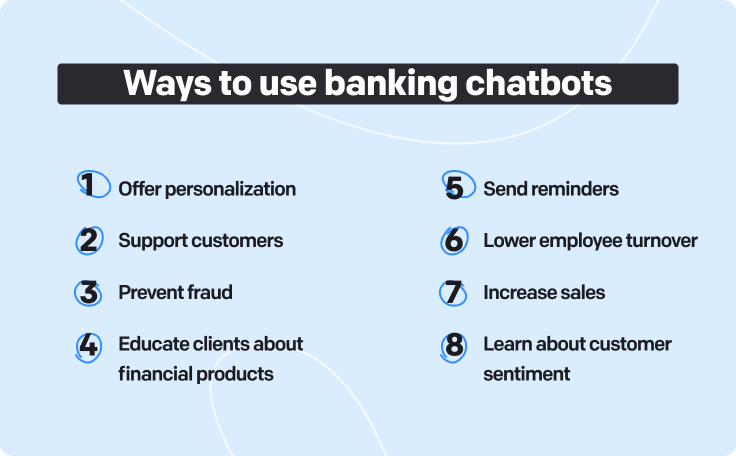
There are numerous chatbot use cases. Let's explore some of the most relevant ones for the banking industry:
1. Conduct essential banking activities
With AI-powered banking technology, customers no longer need to wait in long queues for basic answers. Banking chatbots can automate basic tasks like account management, fund transfers, and paying monthly bills, giving customers a full breakdown of financial activity — spending habits, account balances, average monthly bills — through a single conversation.
2. Answer FAQs
Customers shouldn't have to wait on hold to get answers to common questions: What is my current balance? What are branch hours? How do I apply for a credit card? What loan options are available? A chatbot for the banking industry can answer these routine customer inquiries immediately, regardless of time of day, with minimal human intervention.
3. Provide customer support
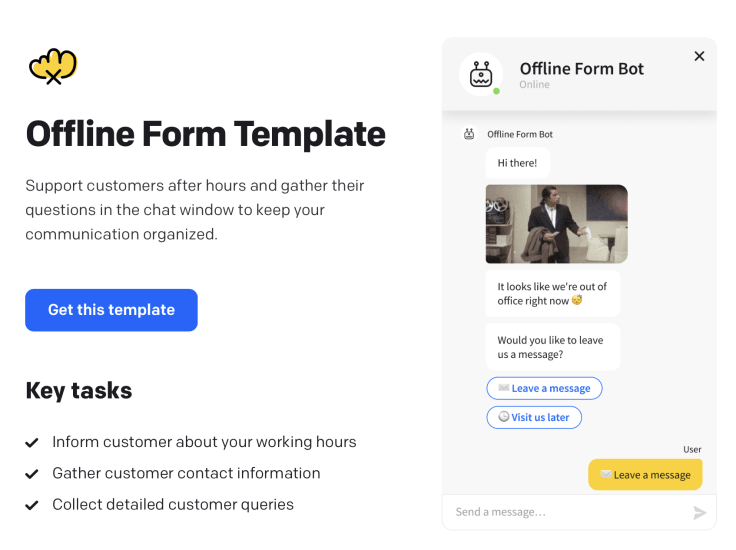
Banking chatbots can send customers proactive notifications about payment reminders, transfer requests, current charges, and credit score updates — support that goes beyond just fixing problems and acts as proactive support, keeping customers in the loop without requiring them to log in and search.
4. Identify and resolve suspicious activity
A chatbot working in the background to flag suspicious activity reduces the risk of fraud reaching a customer's account. Chatbots can alert customers to suspicious transactions in real time, enabling quick verification and improving customer trust and overall customer experience.
5. Facilitate financial product applications and onboarding
Your banking chatbot can guide a customer through a financial product application from start to finish, suggesting the best-fit product based on customer preferences. This extends to onboarding: banks increasingly use chatbots for early-stage Know Your Customer (KYC) steps, which can shrink onboarding timelines from days to hours. Any chatbot involved in onboarding, account opening, or identity verification is part of a regulated process — it still has to comply fully with KYC and Anti-Money Laundering (AML) requirements, regardless of whether a bot or a human is collecting the information. Emerging agentic AI capabilities are starting to let chatbots autonomously gather supporting documents for loan applications, smoothing the process for both customer and bank.
6. Promote reviews and feedback
Banking chatbots make it easy to collect customer feedback, whether through short surveys or long-form forms, giving you a steady stream of input for improving products and service, while helping banks understand user satisfaction and customer preferences.
The fundamentals of banking chatbots
Effective banking chatbots should include a few core components:
1. Conversational
At the most basic level, your banking chatbot needs to feel conversational — customers should feel like they're talking with an actual person in terms of syntax, grammar, and tone. Advanced NLP now lets chatbots understand context and intent rather than just matching keywords.
2. On-brand
Your chatbot is an extension of your company, so it needs to reflect your policies on late fees, due dates, and other core details. Proper backend training before launch prevents a chatbot from distributing inaccurate information that damages your brand image.
3. Transactional
Implementing a banking chatbot should lead to measurable cost savings by supporting broader banking operations, not just alleviating the burden on live customer support agents. Set benchmarks for expected savings — from cross-selling revenue to reduced outsourced service costs — and follow up against actual results.
4. Informative
Answers shouldn't be generic. If a customer asks about a credit card due date, "your bill is due on May 15" builds trust; "due dates vary" doesn't. Specific, accurate answers are what separate a chatbot that helps from one that frustrates.
5. Secure
Protecting sensitive data and sensitive customer data transmitted between your chatbot and the customer is non-negotiable — account numbers, addresses, and identity documents are exactly the kind of data a chatbot handles regularly, which makes it a target. A few non-negotiables: encryption in transit and at rest (TLS or better), independently audited controls such as SOC 2 Type 2, and compliance coverage that matches your regulatory footprint — GDPR with a Data Processing Addendum for EU customers, PCI DSS if payment data is anywhere nearby, with strong security protocols applied across integrations and vendors.
The more effective security decision, though, is often about scope rather than just protocol: the safest banking chatbots are the ones designed to never touch balances, move money, or make credit decisions in chat at all. If a chatbot doesn't have read access to sensitive account data in the first place, there's nothing for an attacker to extract from it — routine questions get answered from public content, and anything account-specific routes to secure, authenticated self-service or a human agent.
This risk isn't hypothetical. In 2018, Ticketmaster suffered a breach that exposed the payment and personal data of roughly 9.4 million European customers — the UK Information Commissioner's Office found the attack vector was malicious code injected into a third-party chatbot script running on its payment page. It's not a banking example, but it's a direct illustration of what can go wrong when a chatbot vendor's security isn't scrutinized as closely as a bank's own systems, particularly on any page handling payment data. Banks are also increasingly adopting Explainable AI (XAI) to provide clear reasoning for automated decisions, supporting both consumer trust and regulatory compliance.
6. Integrated
Your chatbot shouldn't route customers to an entirely different portal — it should operate as an extension of your mobile app or website, and some banks also want tools that integrate seamlessly with websites, mobile apps, and support systems. Make sure it supports seamless integration with your existing banking systems, including customer support databases and knowledge bases, and can connect to legacy systems where needed so responses are grounded in real account data.
7. Analytical
Beyond answering questions, your banking chatbot should compile customer interaction data into reports your team can act on to improve customer communications and service quality over time. If dozens of customers report the same mobile app issue, your development team can resolve it faster.
8. Continuously improving
Most chatbots use some form of machine learning, but always verify continuous improvement is happening in practice — and that improvements stay aligned with your brand voice and compliance requirements as the system evolves into more intelligent systems.
10 of the best banking chatbots in 2026
The popularity of chatbots in banking means you have numerous providers to choose from. When selecting a chatbot provider, keep the fundamentals in mind. You want to choose one that offers the most advantages and scales alongside your business.
Here's a breakdown of top finance chatbots for banks, plus notable in-house solutions built by major financial institutions:
1. ChatBot
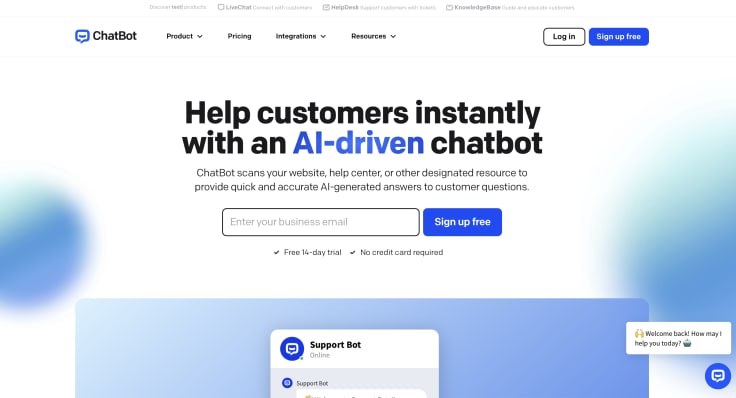
ChatBot takes a deliberately narrow approach for banks: it answers routine questions — fees, rates, card activation, branch hours — from a bank's own published content, captures and routes loan and account leads to the right team, books appointments, and triages urgent cases like a lost card straight to a person with the full conversation attached.
By design, it doesn't read balances, move money, or make credit decisions in chat, so there's nothing sensitive on the table for it to expose. It's SOC 2 Type 2 certified, supports GDPR with a Data Processing Addendum, and includes PCI DSS coverage, two-factor authentication, and encrypted connections on every plan. Financial services proof point: trading platform Funded Trading Plus used it to handle a 15x overnight spike in chat volume during an industry-wide disruption while holding a 93% CSAT rating.
2. Erica (Bank of America)
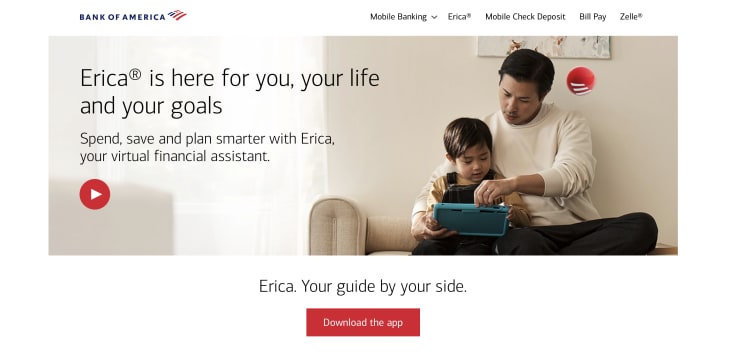
Bank of America's Erica remains one of the most widely adopted AI-powered financial assistants in the world. Since its 2018 launch, Erica reached 1 billion interactions by October 2022 before growing further; 42 million clients have used Erica, with 24.6 million active users and roughly 200 million interactions in Q2 2026 alone — up 23% year-over-year. Cumulative interactions have passed 3.2 billion. Erica helps customers manage account balances, track spending, monitor transactions, and receive personalized financial insights.
3. Eno (Capital One)
Eno is Capital One's conversational AI assistant, available 24/7 to credit card holders. Customers can check balances, review transactions, get account information, and receive fraud alerts through text-based interaction. Eno also generates virtual card numbers for safer online shopping.
4. TARS
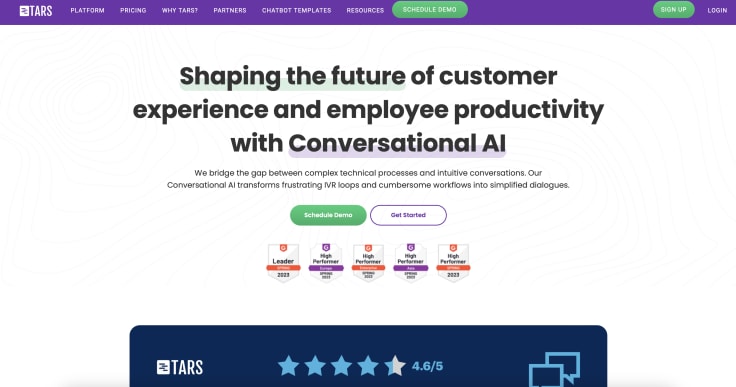
TARS is considered one of the best banking chatbots because of its extensive conversion-funnel options, with hundreds of chatbot templates, a simple setup process, and reporting tools for evaluating performance.
5. Haptik
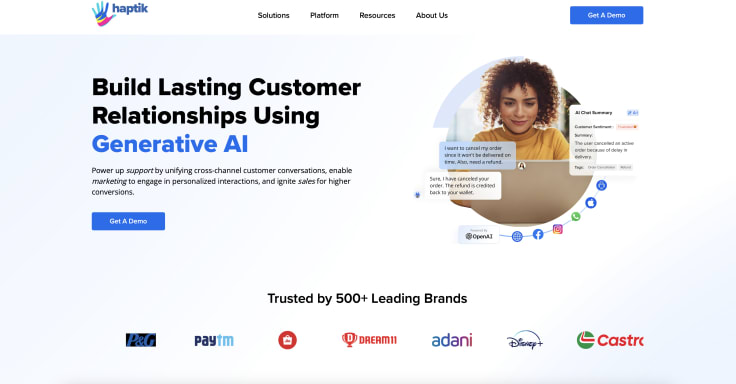
Haptik is a strong option for businesses seeking detailed conversational analytics alongside back-end customer support tooling.
6. Kasisto
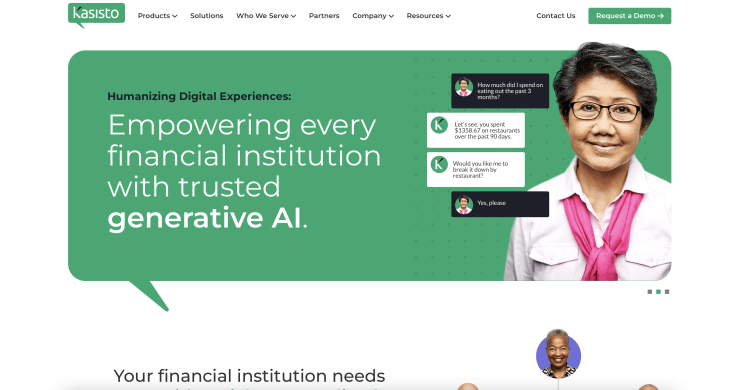
Kasisto uses machine learning to make realistic product recommendations that support cross-sell and upsell strategies, with multiple channels including text, touch, and voice.
7. Kore.ai

Kore.ai stands out for operational efficiency, with comprehensive reporting and integrations across 30+ third-party applications for a single centralized system.
8. Ceba (Commonwealth Bank)
Commonwealth Bank's Ceba can assist with over 200 everyday banking tasks and is available 24/7, resolving a large majority of incoming contacts end-to-end without human support.
9. NOMI (Royal Bank of Canada)
NOMI offers budgeting, cash flow analysis, and spending insights, delivering billions of personalized insights to customers since launch.
10. Ally Bank
Ally Bank uses virtual assistants to improve customer support with faster answers to routine banking questions and smoother digital service experiences.
Banking chatbot implementation best practices
When implementing your banking chatbot, follow a few best practices.
1. Know what your customers want
You could implement the best chatbot on the market, but if it doesn't meet customer expectations, it won't move your value proposition or bottom line. Poor bot experiences can also backfire — 80% of consumers felt more frustrated after interacting with a chatbot. Before implementing a chatbot, understand what your customers are actually looking for — financial habit tracking, 24/7 support, or something else. Customer needs can shift after launch, so revisit this regularly.
2. Align your chatbot with your brand voice
Your chatbot should follow the same principles as your physical locations, website, and phone support — knowledgeable and authoritative, but friendly and approachable. Test your brand voice by asking questions in different ways before rolling out your new chatbot.
3. Regularly review information
AI chatbots use machine learning to continuously adapt, which means brand voice and processes can start to drift from your goals. Make it a priority to review your chatbot monthly, analyzing customer feedback, fixing issues, and confirming functions are optimized.
4. Optimize human agents and chatbots
As helpful as banking chatbots can be, they aren't a substitute for human agents — they're most effective when they trigger human intervention and route complex cases to human representatives, while preserving access to human customer service agents to protect service quality and customer trust. Recent research backs this up directly: Deloitte's 2026 Global Contact Center Survey of US banking customers and executives found that about 70% of customers used self-service in the past year, yet only 25% say it resolves half or more of their issues without a human agent. Customers currently credit AI mainly with convenience — 61% cite 24/7 availability and 40% cite faster response times — but far fewer associate it with accuracy or personalization, which is where trust actually gets built or lost.
Deloitte's recommendation for banks: keep simple, low-risk requests in AI-led self-service, but route high-stakes interactions — fraud, disputes, hardship, complaints, complex lending — to a human, AI-enabled agent rather than trying to automate them away. The practical takeaway: a banking chatbot's value isn't just what it automates, it's how gracefully it fails. When the AI agent can't resolve an issue, it should hand off to a human agent with full context and conversation history preserved — that's what determines whether customers trust the bot again.
5. Prioritize security and compliance
Clear, compliant customer communications matter whenever bots handle banking services, and secure deployment matters across the financial sector, especially when bots connect to messaging platforms. Communication between customers and your chatbot needs to be secure at a basic level — firewall, secure server, and integration into your existing systems to minimize unsafe connections. Understand which financial institution security regulations apply to your chatbot, including what customer data you can store and how you can use it.
Any chatbot touching onboarding or account opening needs to satisfy KYC and AML requirements as part of that process, not as an afterthought. Banks are increasingly deploying Zero-Trust security architectures, biometric defenses, and advanced encryption protocols to keep chatbot interactions safe.
Enable AI chatbots in banking industry
The shift in customer expectations bodes well for the future of chatbots. Whether your organization is considering a banking chatbot for the first time or looking to switch providers, the question isn't whether to adopt one, but how to make it work hardest for your business.
ChatBot is built with banking's constraints in mind and can help banks deliver exceptional customer experiences: it answers from your own published content rather than requiring a core-system integration, so most teams are live the same day instead of running a months-long IT project. Routine account, card, and fee questions get resolved instantly, which supports exceptional customer experiences without exposing sensitive account data; anything sensitive — a lost card, a dispute, a complex loan question — reaches your team in seconds with full context attached, and nothing account-specific ever passes through the chat itself. If you're evaluating options specifically for a bank or credit union, our AI chatbot for banking page covers the security certifications and channel coverage in more depth, along with our proven track record in regulated banking environments.
FAQs
How do banking chatbots work?
Banking chatbots use artificial intelligence and machine learning to respond to customer queries. Using natural language processing, the chatbot facilitates a human-like conversation. More complex chatbots use large language models (LLMs) to analyze patterns between words and predict appropriate responses, while simpler rule-based chatbots rely on decision-tree logic or keyword databases. Unlike human support agents, banking chatbots are available 24/7. For any task a banking chatbot can't handle, it refers the customer to a live agent with full conversation context preserved.
What services can banking chatbots offer?
Most chatbots focus on answering basic customer questions like payment due dates, available banking products, and spending habits. Some extend further — enabling users to complete common tasks in chat, including loan applications, transferring funds, and checking account balances and transaction history. AI chatbots can also provide personalized insights, and some can offer personalized financial advice when connected to the right data and controls, like budgeting tips or savings plan suggestions based on individual financial data.
Are chatbots in banking secure?
Yes, when implemented properly — but check the certifications, not the marketing copy. Look for independently audited controls such as SOC 2 Type 2, GDPR compliance backed by a Data Processing Addendum, and PCI DSS coverage if payment data is anywhere near the conversation. Two-factor authentication and encrypted (TLS) connections should be standard on every plan, not an enterprise upsell. The safest design choice many banking chatbots make is scope: not handling balances, transfers, or credit decisions in chat at all, so there's simply nothing sensitive to expose if something goes wrong. Many banks also use Explainable AI (XAI) to provide clear reasoning for automated decisions, supporting both consumer trust and compliance.
Do banking chatbots need to comply with KYC and AML regulations?
Yes. Any chatbot involved in onboarding, account opening, or identity verification is part of a regulated process, and the compliance obligation applies regardless of whether a bot or a human is doing the collecting.
Can chatbot technology handle complex customer interactions?
Chatbots handle most routine interactions well, and for anything they can't resolve, the customer is referred to a live agent. Chatbot technology has advanced significantly — AI chatbots now understand context, handle multi-step requests, and learn from past interactions. Many customers still prefer human interaction for truly complex issues, and that's fine; customer trust depends on handing those cases to humans instead of forcing automation, so the goal is routing simple tasks to the chatbot so human agents can focus on conversations that matter most.
How does artificial intelligence prevent and detect fraud?
AI uses machine learning to evaluate a customer's spending habits and flag suspicious activity, then sends a request to the customer to verify the transaction's legitimacy. If the transaction is fraudulent, the chatbot can freeze the account and bring in a live agent to evaluate the situation — more accurate and faster than manual review alone.
How do banking chatbots integrate with existing infrastructure?
This varies more than most vendors admit. Some banking chatbots require seamless integration with existing banking systems to pull live transaction history and account data, and some deployments span websites, mobile apps, and other messaging platforms — powerful, but a genuinely heavy lift, and it expands what a breach could expose. Others, including ChatBot, take the opposite approach on purpose: they answer from a bank's published content (website, help center, rate pages) rather than touching core systems at all, which means no months-long integration project, but also means account-specific requests get routed to secure self-service or a human rather than answered directly in chat. Neither approach is universally "better" — it depends on whether you want the chatbot doing more, or exposing less.