
Showing top 0 results 0 results found
Showing top 0 results 0 results found



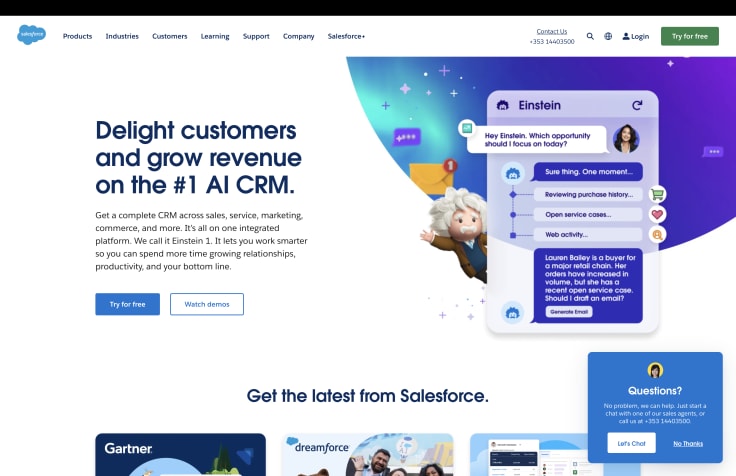
Salesforce is a dominant CRM and customer support tool, but it’s not the only choice. Many businesses need something different - whether it's more affordable, easier to use, or simply better suited to their specific needs.
Let’s explore the best alternatives to Salesforce Service Cloud, with a focus on ChatBot, which comes highly recommended by users on platforms like G2.
We’ll provide detailed insights into various options, helping you understand their unique features and advantages. Whether you're a startup needing something simple and affordable or a large enterprise seeking advanced features, our guide will help you find the perfect match to elevate your customer support game.
Why consider Salesforce alternatives?
Salesforce still leads the CRM and customer service market, and plenty of businesses still look elsewhere. Sometimes for budget, sometimes for speed of setup, sometimes because the platform does far more than the team needs.
Two things changed in this market during 2026, and both affect anyone comparing options right now. Salesforce agreed to buy one of the alternatives on this list. Another vendor announced it is leaving the sales CRM business entirely. Both are flagged below.
All pricing here was verified against vendor pages in August 2026. Check before you buy, because this category reprices often.
What you'll learn from this article
Why consider Salesforce alternatives?
Salesforce is a capable platform. These are the four reasons teams most often start shopping.
1. Comparatively costly
The $25 headline is real, and it is not the tier a support operation runs on. Salesforce Service Cloud is priced per user per month across five editions: Starter Suite at $25, Pro Suite at $100, Enterprise at $175, Unlimited at $350, and Agentforce 1 Service at $550. Everything above Starter is billed annually.
Enterprise is the first tier that includes AI for customer service, a self-service help center, and workflow automation. For most mid-market service teams, $175 per user per month is the honest floor, not $25.
Note that Salesforce retired the old Essentials edition. Any comparison still quoting an Essentials price is out of date.
2. Steep learning curve
Salesforce rewards configuration, which means it also requires it. Teams commonly need weeks or months to reach proficiency, and implementation is usually scoped and quoted separately from licenses. That is fine if you have an admin. It is a real cost if you do not.
3. Need to buy add-ons
The base license rarely covers everything. Agentforce is available on the top edition or as a paid add-on, and support, analytics, and industry functionality are commonly separate lines. Premier Support alone is often priced as a percentage of net license fees.
The practical effect is that budgeting requires modeling three layers: license, add-ons, and implementation.
4. Reputation of customer support
Users frequently cite response times and the difficulty of reaching someone with real authority, particularly on lower tiers where premium support is not included. Smaller vendors often compete directly on this.
Top 10 Salesforce alternatives for your business
At a glance
Salesforce Service Cloud is included as the baseline so the comparison has a reference point. Prices are per user or per seat, per month, on annual billing unless noted, verified August 2026.
|
Tool |
Best for |
Starts at |
Where teams land |
AI billing |
|---|---|---|---|---|
|
Salesforce Service Cloud (baseline) |
Enterprise platform consolidation |
$25 |
$175 (Enterprise) |
Agentforce on top tier, or add-on from $125 |
|
ChatBot.com |
Support automation with revenue attribution |
$19 |
$79 (Growth) |
Included in plan |
|
DevRev |
B2B SaaS wanting support and product in one loop |
~$20 |
Not published |
Not published |
|
HubSpot Service Hub |
Teams already on HubSpot CRM |
~$15 |
$90 (Professional) |
~$0.50 per resolved conversation |
|
Fin ( formerly Intercom ) |
Existing Intercom teams |
Seats plus usage |
Seats plus usage |
$0.99 per outcome |
|
ServiceNow |
Enterprise IT and customer service together |
Quote only |
Quote only |
Quote only |
|
Microsoft Dynamics 365 |
Organizations committed to Microsoft |
Varies by module |
Varies by module |
Varies by module |
|
Zoho CRM |
Cost-conscious teams |
$14 |
$40 (Enterprise) |
Zia included from Enterprise |
|
Zendesk Sell (retires 31 August 2027) |
Support-heavy operations |
~$19 (Support Team) |
$55 to $115 (Suite) |
~$1.50 to $2.00 per resolution, reported |
|
Pipedrive |
Sales pipeline management only |
$14 |
$29 to $59 |
Add-on |
|
monday CRM |
Teams already on monday.com |
~$12 (3-seat minimum) |
~$28 |
Add-on |
"Quote only" and "not published" mean the vendor does not publish a rate, rather than that we could not find one. Treat any comparison article that fills those cells with a confident number as modeled rather than sourced.
1. ChatBot
Best for: teams that want support automation and revenue attribution without buying a full CRM
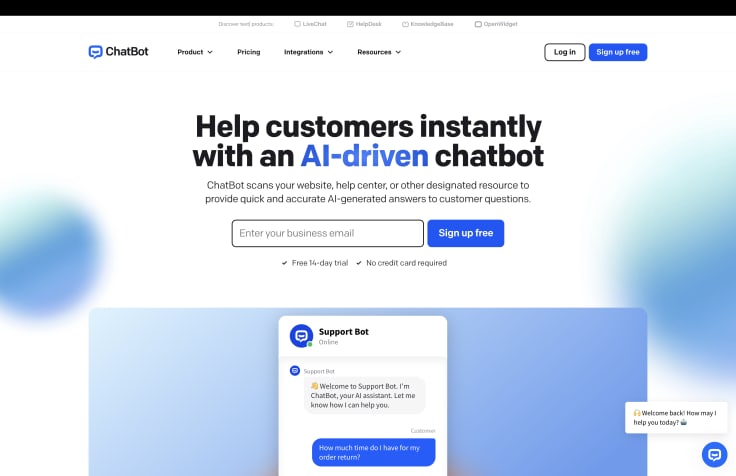
Worth being precise about the category. ChatBot.com is not a CRM replacement. It is the AI Agent inside Text, covering AI-driven support, live chat, and ticketing in one workspace. If what pushed you off Salesforce was the cost and complexity of Service Cloud rather than a need for full CRM, this is the lighter answer.
Key features
- AI Agent trained on your content. Websites, uploaded files, and articles written in-app. Tone of voice, response length, and custom instructions up to 10,000 characters. Replies in 48 languages.
- No-code builder. Your support team owns the configuration rather than filing tickets with engineering.
- Multichannel. Website chat, WhatsApp, Messenger, SMS, and in-app.
- Sales attribution. Orders closed in chat link back to the conversation that produced them, with a live Shopify catalog behind product recommendations.
- Security. SOC 2 Type 2, GDPR, CCPA, and PCI DSS, with SSO and audit logs on Enterprise.
Comparison with Salesforce
- Scope. Salesforce is a platform covering CRM, service, field service, and commerce. ChatBot.com covers service and the selling that happens inside it. Different purchase, not a like-for-like swap.
- Time to value. Most teams go live the same day. Service Cloud implementations are typically scoped as projects.
- Pricing. $19 per user per month on Essential and $79 on Growth, billed annually, with AI resolutions included in the plan rather than metered separately. Enterprise is custom. 14-day free trial, no card.
2. DevRev
 Best for: B2B SaaS companies that want support and product engineering on one system
DevRev is an AI-native platform built on what the company calls AgentOS, unifying customer support with product development. Tickets link directly to product parts, so support volume feeds the roadmap instead of dying in a queue. Its Turing bots handle deflection and self-service.
Key features
- Knowledge graph reasoning. Rather than retrieval against a flat knowledge base, DevRev maps relationships between customers, issues, product features, and known bugs, so an agent can surface that three other accounts hit the same error last week.
- Support-to-product loop. Customer requests connect to roadmap prioritization, which is the core reason teams pick it.
- Custom AI agents. Composable agents with distinct skill sets, so billing disputes and API questions get handled differently.
- Unified inbox and analytics. Ticketing, auto-routing, and dashboards covering sentiment and recurring issues.
Comparison with Salesforce
- Focus. Salesforce separates service from product management. DevRev is built on the premise that splitting them is the problem.
- Fit. Strongest for B2B SaaS with an engineering team. Less relevant for retail or field service, where Salesforce is far deeper.
- Pricing. Not fully published. G2 lists an entry tier around $19.99 per user per month with three plans; anything beyond that is a sales conversation.
3. HubSpot Service Hub
 Best for: teams already using HubSpot CRM who want service on the same record
Service Hub covers ticketing, help desk workflows, knowledge base, customer feedback, and CRM context in one place, and it integrates with more than 1,500 apps.
Key features
- Ticketing and automation. Routing, automated responses, and SLA tracking from Professional up.
- Knowledge base and self-service.
- Live chat and Breeze Customer Agent. HubSpot's AI agent, available on Professional and Enterprise.
- Feedback and surveys. NPS, CSAT, and feedback forms.
- Native CRM integration. The main reason to pick it, if you are already on HubSpot.
Comparison with Salesforce
- Ease of setup. Meaningfully faster than Service Cloud for a comparable feature set at the mid tier.
- The Professional cliff. Starter to Professional is where the cost jumps, and Enterprise carries a 10-seat minimum.
Pricing
Free tier, Starter around $15 per seat per month, Professional at $90 per seat per month billed annually, and Enterprise at $150 per seat. Budget for one-time onboarding fees on Professional and Enterprise. Since 14 April 2026, Breeze Customer Agent bills on outcomes at roughly $0.50 per resolved conversation, so model AI as a separate variable line.
4. Fin (formerly Intercom)
 Best for: teams already on Intercom, with a significant caveat
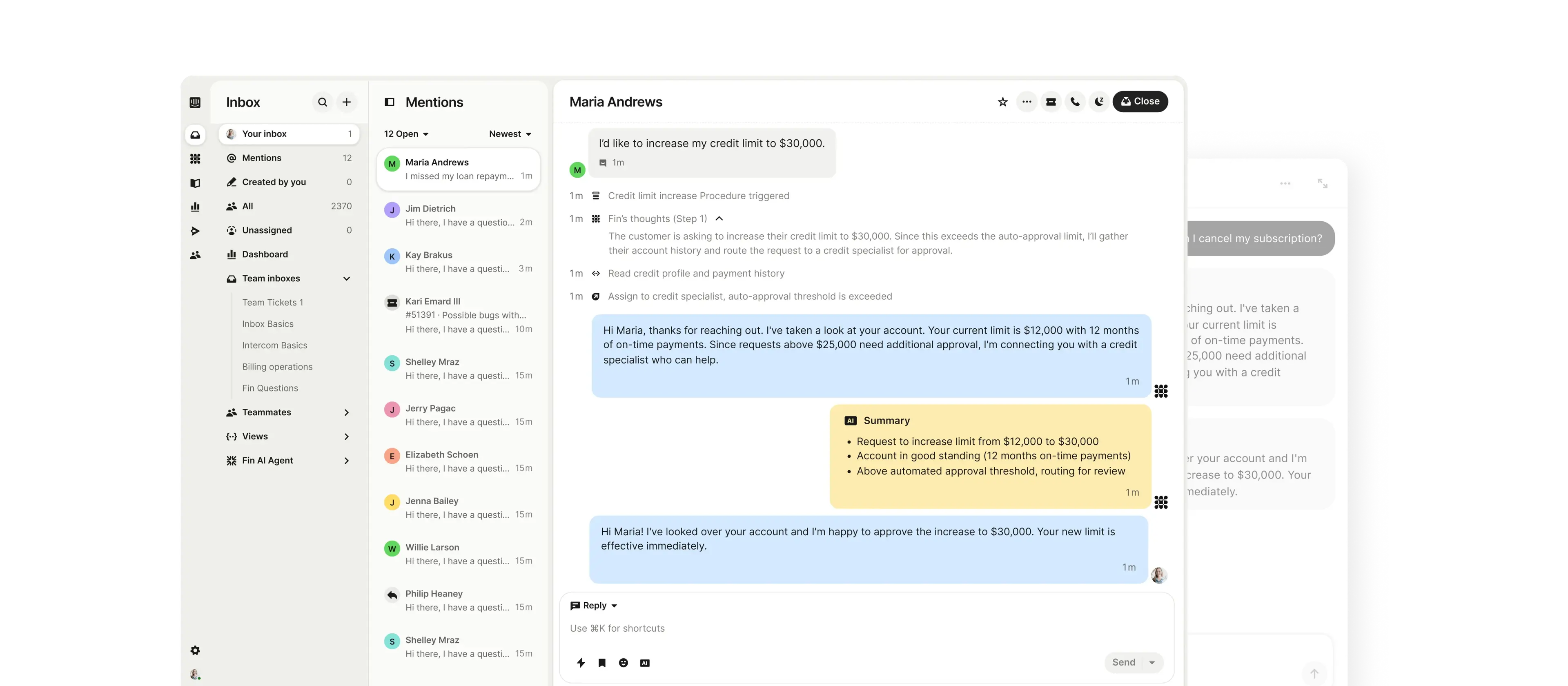
Status change: this listing is the reason to read the date on any comparison article. Intercom renamed itself Fin in May 2026, and on 15 June 2026 Salesforce signed a definitive agreement to acquire Fin for approximately $3.6 billion. The deal is expected to close in Salesforce's fiscal Q4 2027, subject to regulatory clearance.
If your reason for leaving Salesforce is strategic rather than budgetary, this alternative is on its way to becoming Salesforce.
Key features
- Fin AI Agent. Runs on Apex, a model the company post-trained for support. Salesforce cites roughly 76% of support requests resolved without a human, though independent analyses of published case studies land lower.
- Genuine multichannel reach, including voice, email, WhatsApp, SMS, and Slack.
- Mature messenger, help center, and workflow automation.
Comparison with Salesforce
- Convergence. Fin arrives pre-trained and deploys in days. Agentforce is deeply customizable and slower to stand up. Salesforce bought Fin specifically to sell both.
- Pricing. $0.99 per outcome (resolution, procedure handoff, or disqualification), $9.99 for a lead qualification, on top of seat costs, with a 50-outcome monthly minimum. Pricing has not changed since the announcement, but packaging after a close is harder to predict.
- Contract risk. Weigh a multi-year commitment carefully while the acquisition is pending.
5. ServiceNow
Best for: large enterprises running IT and customer service on one workflow engine
ServiceNow covers IT service management, customer service management, and business process automation. Where Salesforce starts from the customer record, ServiceNow starts from the workflow.
Key features
- ITSM. Incident, change, and problem management with a service catalog.
- CSM. Case management, knowledge management, self-service portals, and omnichannel support.
- Process automation across departments.
- Service portals and dashboards with SLA visibility.
- Deep enterprise integration across CRM, ERP, and HRIS.
Comparison with Salesforce
- Center of gravity. ServiceNow is stronger where customer service and internal IT overlap. Salesforce is stronger where service and sales overlap.
- Scale. Both are enterprise platforms with enterprise implementation timelines. Neither is a quick swap.
- Pricing. Quote-based, structured by module and user role. No public rate card, so budget for a procurement cycle.
6. Microsoft Dynamics 365
Best for: organizations already committed to Microsoft 365 and Azure
Dynamics 365 spans CRM and ERP, and its main argument is the rest of your Microsoft stack: Teams, Outlook, Power BI, and Azure.
Key features
- Native Microsoft integration. The genuine differentiator.
- Modular licensing. Buy sales, service, or field service separately rather than as one platform.
- Power Platform. Power Automate and Power Apps for customization without a dedicated developer team.
- Copilot Service workspace, now Microsoft's recommended agent desktop.
Comparison with Salesforce
- Ecosystem lock. If your company runs on Microsoft, integration cost drops sharply. If it does not, that advantage disappears.
- Migration note. Microsoft is deprecating Dynamics 365 Unified Service Desk, with quality and security updates ending 30 April 2027 and full retirement 30 June 2028. Existing USD customers should be planning a move to Copilot Service workspace now.
- Pricing. Per app, per user, and it varies enough by module and agreement that a published figure would mislead. Get a quote.
7. Zoho CRM
 Best for: cost-conscious teams that may need more than a CRM later
Zoho CRM delivers a broad feature set at a fraction of Salesforce pricing, with AI assistant Zia, multichannel support, and multi-currency handling for international operations.
Key features
- Zia. AI assistant covering suggestions, task automation, and sales prediction.
- Command center for building and visualizing customer journeys.
- Multilingual and multi-currency support.
- Wide third-party integration.
- Zoho One. The strategic differentiator. Around $45 per user per month bundles 45-plus business applications, which is less than a single HubSpot Professional seat.
Comparison with Salesforce
- Value. For features roughly comparable to Salesforce Enterprise, Zoho is dramatically cheaper.
- Polish. The tradeoff is interface refinement and ecosystem depth. Salesforce has a far larger partner and app marketplace.
- Pricing. Standard $14, Professional $23, Enterprise $40, Ultimate $52 per user per month, with a free plan for up to three users.
8. Zendesk Sell
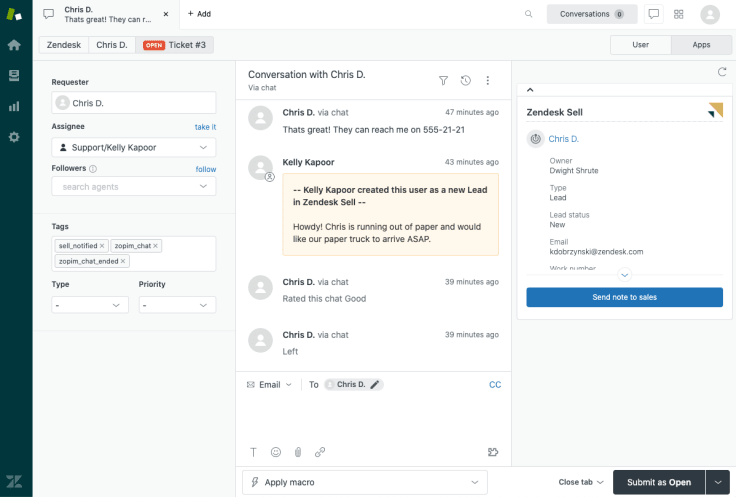
Best for: support-heavy operations that want a mature ticketing platform
Status change: Zendesk announced on 9 September 2025 that Sell and its mobile app retire on 31 August 2027, exiting the sales CRM business. Existing customers keep full access until then, and Zendesk named Pipedrive as its migration partner. All Sell data is deleted at subscription end or from 31 August 2027, whichever comes first.
No new team should deploy Sell in 2026. Zendesk's service platform is the product with a future, and it is the real Salesforce Service Cloud competitor.
Key features
- Omnichannel ticketing across email, chat, phone, and social.
- AI agents that resolve conversations autonomously.
- Knowledge base and help center.
- Copilot for agent-side assistance, sold as a separate per-agent add-on.
- Large marketplace with 1,800-plus apps and integrations.
Comparison with Salesforce
- Depth versus breadth. Zendesk is a better help desk. Salesforce is a better platform. That is the whole trade.
- AI billing. Suite runs roughly $55 to $115 per agent per month on published annual tiers. AI agents bill per automated resolution at a rate Zendesk does not publish, with third-party analyses converging around $1.50 committed and $2.00 pay-as-you-go. Overage auto-bills.
9. Pipedrive
 Best for: sales teams that want pipeline management and nothing else
Pipedrive is a focused, visual sales-pipeline tool. Its scope is narrow by design, and that is the appeal. It is also now Zendesk's named migration partner for departing Sell customers, with purpose-built migration tooling.
Key features
- Visual pipeline. The clearest deal view in the category.
- Workflow automation for follow-ups and lead qualification.
- Email campaign builder.
- Zendesk migration tools, relevant if you are moving off Sell.
- Large integration marketplace.
Comparison with Salesforce
- Simplicity. Non-technical users are productive in days. That is the reason to choose it.
- Ceiling. No marketing module and no service platform. If you need those, you will buy them separately.
- Pricing. Lite from $14 per seat per month billed annually (around $24 monthly), rising to $79 on Ultimate. No free plan, 14-day trial.
10. Monday Sales CRM
Best for: teams already running monday.com for project management
Now branded monday CRM rather than Monday Sales CRM. It leverages monday.com's visual workflow interface and shares data with the wider work management platform.
Key features
- Fast setup with minimal onboarding.
- Customizable boards, dashboards, and automations.
- Native monday.com integration. The main reason to choose it.
- Mobile apps for iOS and Android.
Comparison with Salesforce
- Interface. Genuinely easier. Also less capable once processes get complex.
- Fit. Compelling if monday.com is already your operating system. Otherwise the case is weaker than Pipedrive's or Zoho's.
- Pricing. From around $12 per seat per month with a three-seat minimum, up to roughly $28.
Conclusion
Choosing the right CRM and customer support platform is essential for streamlining your business operations and boosting customer satisfaction.
While Salesforce remains a popular option, it's important to consider alternatives and competitors. This software can offer more tailored solutions that are cost-effective, user-friendly, and packed with features that meet your needs. By exploring these options, you can find a solution that fits your budget, enhances your team's efficiency, and improves overall customer experience.