

Showing top 0 results 0 results found
Showing top 0 results 0 results found



AI chatbots have changed how businesses answer customer questions and automate customer service. They can handle up to 80% of routine tasks, run 24/7, and free your team to focus on conversations that actually close deals. But one poorly designed bot can undo all of that in a single frustrating interaction.
Customers expect fast, accurate, personalized support. When a chatbot falls short, they leave. And the chatbot mistakes that cause this are almost always preventable.
13 chatbot mistakes to avoid
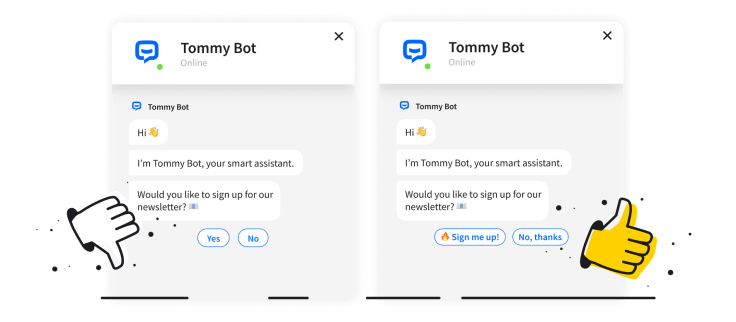
AI chatbots should improve customer satisfaction and lighten the load on your support team, not create new problems. I recommend that your business avoids these common mistakes, which can turn a promising chatbot into one that misses the mark.
1. Your chatbot's personality is off
One of the chatbot mistakes that's easy to overlook: the bot has no personality. Imagine using a voice assistant in your home, like Alexa. She might recognize your voice, but she's too robotic, and she doesn't even know your name.
Give your chatbot a personality by creating chatbot names that resonate with your customers and adding your company's logo to the chatbot icon. Then work on your introductory message. "How can I help you?" is far less inviting than, "Hi, I'm Wilson, an AI-powered chatbot trained to answer all your questions."
Defining a chatbot's purpose and personality helps align it more closely with user expectations and brand voice. That personal touch is what separates a forgettable bot from one people want to use again.
2. You didn't test your bot enough before launch
AI virtual assistants and chatbots must be thoroughly tested. Rigorous testing before launch or before deploying new features is the easiest way to avoid critical chatbot mistakes. You can hire in-house or work with a third-party QA team to try to "break" the bot, ask it questions, and judge responses.
In real-world scenarios, users will do things that "break" your bot. If you slowly introduce it and limit its use to certain users or regions, you can review the logs and correct any odd behavior before a full rollout.

Releasing customer-facing AI chatbots without robust testing can have undesirable consequences. A good example: a bot that provides inaccurate pricing or return policy information can do more harm than having no bot at all. Continue monitoring the bot after launch, too, as new features are added or old ones are updated.
3. You didn't have a plan
If you review our chatbot examples, you'll notice each successful chatbot has one thing in common: a plan. Establish the purpose of your chatbot, create a strategy, and define your use cases.
For example, let's say your live chat support queue is 30 to 40 minutes long, and you're confident you're losing potential customers as a result. Your chatbot's purpose may be to reduce wait times to 1 minute and free up your team so they can focus on email or phone support.
If you don't know your bot's purpose, sit down with your marketing, sales, and support teams. Ask where they're struggling, what can be improved, and how introducing an AI chatbot can help you reach your goals and increase sales.
4. You don't offer users an easy exit option
Here's one of the chatbot mistakes that even the world's largest businesses have made: making it difficult to exit the chatbot. If you don't offer users an easy exit option, customer satisfaction will suffer, bot effectiveness will decline, and you may lose customers.
Make it as easy as possible to leave the conversation loop. Place large "X" buttons at the top or bottom right of the bot, and be mindful of your color choices so the exit is easy to find. This small precaution can make a real difference in customer satisfaction.
5. You're not escalating complex issues to support agents
Most chatbots are great at answering common questions. Complex issues are a different story. If your bot doesn't resolve an issue, many companies mistakenly let customers get stuck in a "bot loop," with no way out except leaving your site. A significant percentage of consumers switch to competitors due to poor customer support, and the reality is that chatbots are typically unable to resolve complex issues on their own.

Implementing clear fallback and escalation logic enables bots to detect user frustration and transfer chats to live agents who can resolve the issue. Set options for customers to request a person, and add triggers where the bot connects to a live agent on its own.
Chatbots should augment your customer support channels, not replace them. Rapid routing that the customer doesn't even notice can greatly improve the customer experience. The best setup? AI handles the speed; human agents handle the relationships.
6. Your chatbot technology is too limited
If you start with a bot that is too basic, it may be a mistake you cannot overcome. Ecommerce solutions need an AI agent that can help answer complex questions on usage, sizing, shipping, and more. Advanced AI-powered solutions can overcome many limitations of traditional chatbots by providing better customer engagement and handling sensitive topics that simpler bots fumble.
Consider everything your bot offers. It may need to communicate and exchange data with other AI tools, authenticate shoppers, or share information between platforms. Make sure the technology matches the complexity of your customers' needs.
7. You're not using analytics to improve
You may have many ideas for your chatbot. Some will be right, and some will be wrong. Analytics can help you test and refine your chatbot over time.
Focus on metrics like bots triggered, user engagement, handoff percentage, and leads captured. Error messages, customer satisfaction scores, and bounce rate should all be analyzed. Continuous monitoring and retraining of chatbots are necessary to improve their performance and coverage for user intent. These customer insights tell you what's working and what's silently driving people away.
8. Your chatbot message is too scripted
It's natural to want to make your chatbot script more restrictive to maintain control of the conversation. But rigid conversation flows cause chatbots to break when users act unexpectedly, leading to conversational dead ends. Bots often generate generic error messages without offering alternatives, and that is a fast way to lose someone.
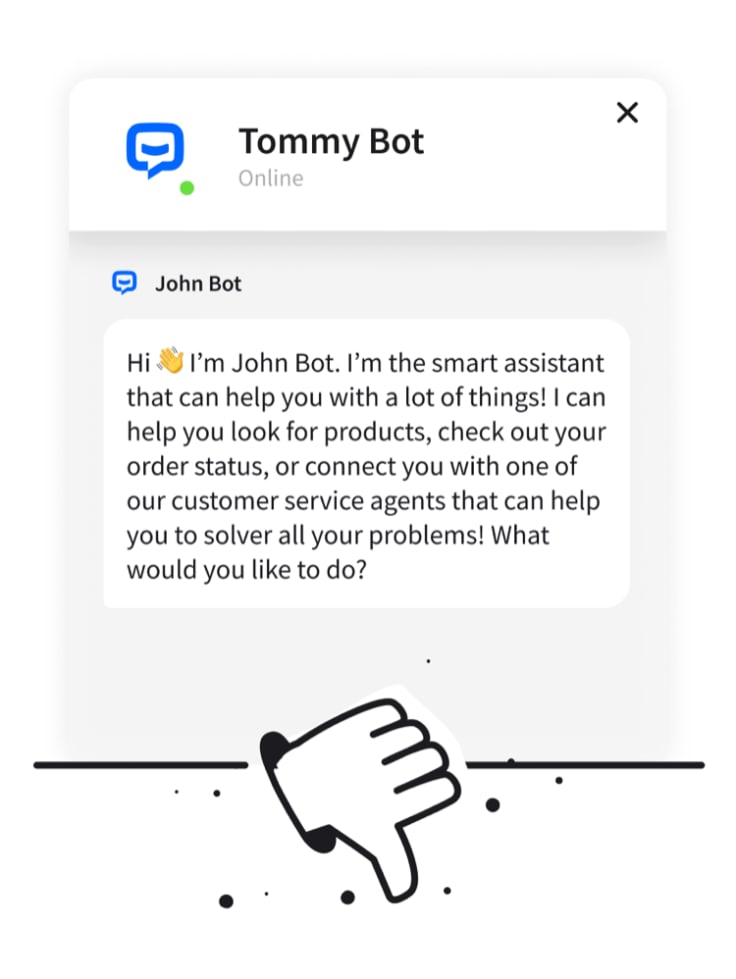
Conversational AI allows your chatbot more flexibility. Users can ask questions and get help in a more natural way. And when your AI model is only fed training data from your business, not external sources, you still maintain control. You also ensure that your customers get relevant answers free of hallucinations (the phenomenon where AI generates incorrect or fabricated information with high confidence).
9. Your user interface is too simplistic
Another big mistake: the chatbot user interface (UI) is too simplistic. Users become disinterested, frustrated, and leave. Make sure your UI is intuitive and user-friendly. Whenever possible, add buttons to make it quick and easy for users to start and continue the conversation.
Study other successful UI examples to get a better feel for what works and what doesn't.
10. You're using proactive chat improperly
Proactive chat has benefits, but it must be set up properly to avoid frustrating users. You risk losing a customer if your proactive messages appear without qualifying questions or confirming the user's interests.
Reach users at the right time when they need your assistance. For example, if a visitor is spending more than a few minutes on a page, send a chat invitation with a customized message based on their browsing behavior. Using user-specific data for responses helps maintain personalization, making answers more relevant and tailored to what that person actually needs.
11. Your bot doesn't understand conversational context
Users can easily become frustrated and leave if your chatbot doesn't understand conversational context. Context loss, where the bot fails to remember previous messages, disrupts the entire interaction.
Modern AI systems using natural language processing can recognize speech and text input, understand queries, and mimic human interactions across languages. Maintaining context allows bots to remember user details and improve the conversational experience. Chatbots that lack personalization and context treat every user the same, failing to leverage past interactions or user data.
12. You built the chatbot from scratch
Far too many businesses make the mistake of building their AI chatbots from scratch, investing time and resources only to reinvent the wheel. Existing frameworks provide all the features you'll need, with built-in integrations right out of the box.
ChatBot, for example, lets you launch an AI agent trained on your own business data in minutes, with no code required. In most cases, you can customize the solution to meet your needs without hiring a development team.
13. You expect too much from your chatbot
Another mistake: setting expectations too high. Chatbots may oversell their capabilities, and when the reality doesn't match, you're left with disappointed customers and a solution that creates more problems than it solves.
Conversational AI has come a long way, but it cannot replace the human element of customer service. Some problems require a real person's help and a degree of empathy that AI simply cannot replicate. Chatbots generally need better data, clearer boundaries, and human oversight to perform at their best.
What are chatbot strengths and weaknesses?
There are many use cases for AI chatbots. Let's look at where they perform well and where they struggle.
Advantages of using chatbots
As long as you avoid making the mistakes above, chatbots can benefit your business in many ways. They can automate customer service for routine customer inquiries, improve customer satisfaction by solving problems quickly, and reduce costs at low cost compared to scaling a full support team. They also provide customer insights by analyzing interactions, deliver personalized support around the clock, and handle a high volume of customer inquiries simultaneously.
Research consistently shows that chatbots provide speedy support for simple issues. When they're connected to the right platform, they also become a profit engine, surfacing buying signals and routing interested customers to the right conversation at the right time.
Disadvantages and limitations
Chatbots are not human agents. Complex issues still require a real person with emotional intelligence. They require ongoing maintenance and updates to generate responses that are accurate. Many customers prefer speaking with a human, particularly for sensitive topics. Without proper safeguards, chatbots can give inaccurate information, and bias in responses can stem from prejudices in their training data.
These disadvantages are manageable. A hybrid customer support system (AI for speed, humans for trust) paired with regular optimization is the best path forward.
Do site visitors prefer chatbots or live support?
The future of chatbots looks strong. Research shows that a majority of consumers prefer chatbots for straightforward questions because they get faster answers.
But "prefer" has a condition: the chatbot has to work well. If it generates responses that are off-topic, fails to understand context, or gives inaccurate information, that preference evaporates. Offering both live chat and chatbot assistance is the smart play because it ensures you appeal to everyone.
When chatbots work best
Chatbots shine when they respond to common questions quickly, collect customer data before a handoff, and route interested buyers to the right conversation. They work best as part of a broader system where AI handles the volume, and humans step in for nuance.
When to bring in a human
Any time a customer asks about something complex, emotional, or high-stakes, a real person should be available. Chatbots that try to handle everything end up handling nothing well. The companies getting this right see every customer conversation as an opportunity, not just a ticket to close.
How to avoid chatbot mistakes
The common thread across all 13 mistakes is the same: companies treat chatbots as a set-and-forget solution instead of something that needs planning, testing, monitoring, and a human safety net. Build your chatbot with clear boundaries, keep your training data accurate, and always give customers a path to a real person.