



Ecommerce support has spent the last two years absorbing AI. In 2026 it starts absorbing the consequences: new disclosure law, new discovery channels, and customers who arrive already half-informed by an assistant you do not control.
Here are seven trends shaping ecommerce customer support this year, with the current numbers behind each one.
What you'll learn from this article
- What is customer support, and why does it matter?
- Ecommerce customer service trends in 2026
- Grow your ecommerce business with ChatBot.com
What is customer support, and why does it matter?
Support helps customers get the most from your product and solves the specific problem that brought them to you.
"Ecommerce customer support" and "ecommerce customer service" get used interchangeably, though they are not identical. Customer service covers the full set of interactions that shape someone's experience of your brand. Support is the subset aimed at resolving a particular issue.
The quality of that resolution decides whether someone buys again. And by customers' own account, most brands are still getting it wrong. Zendesk's CX Trends 2026 report, its eighth annual edition, draws on more than 11,000 consumers and CX leaders worldwide. It found that 83% still believe customer experience should be far better than it is today.
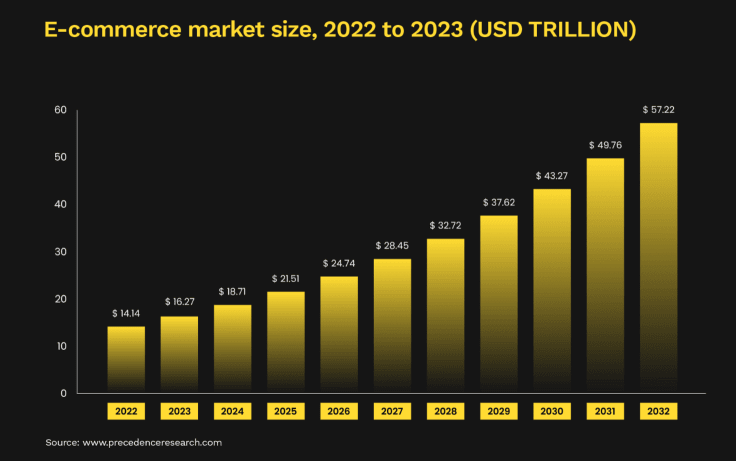
Two numbers show how directly support quality now touches revenue in ecommerce specifically. According to the NRF and Happy Returns 2025 Retail Returns Landscape, 81% of consumers read a return policy before purchasing, and 82% say free returns matter when deciding where to shop, up from 76% the year before. Support policy is doing pre-purchase work whether or not you treat it that way.
Ecommerce customer service trends in 2026
1. Personalized shopping and customer experience
Personalization in 2026 depends less on demographic targeting and more on continuity. The question is whether your systems remember the customer who chatted last week about a delayed order, or make them explain it again.
Zendesk frames this as memory-rich AI: context that persists across interactions rather than resetting at every handoff. Siloed systems are what force people to repeat themselves, and repetition survives every generation of support tooling.
For support teams: map where your stack drops context. Chat to ticket, bot to human, channel to channel. Each break is a place the customer starts over, and each one is fixable without buying anything new.
AI Agent in ChatBot.com uses conversation history and customer data to tailor replies, and hands off to a human with the thread intact.
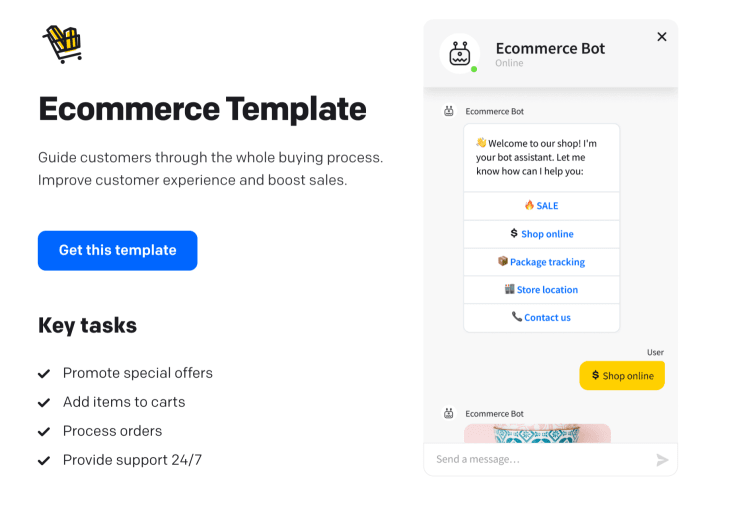
You can take a personal approach to your customers by installing ChatBot on your website and using an ecommerce template that allows you to:
- show off your products,
- add products to carts,
- promote special deals,
- track packages,
- show store location,
- make a call,
- provide contact details.
2. Artificial intelligence
The measure of a support bot has changed. Deflection counted conversations that ended without reaching a human, which treats abandonment and resolution identically. That is why teams optimizing for deflection kept reporting strong numbers alongside falling satisfaction.
Resolution is the 2026 measure, and vendors have restructured billing around it. Several now charge per resolved conversation rather than per seat.
For support teams: pull a week of transcripts where the conversation ended without escalation, and read them. The gap between "ended" and "resolved" is usually where your CSAT is leaking.
Treat published resolution rates as ceilings. Vendors quote best-case figures from mature deployments, and independent reviews of those same case studies consistently land lower. Forecast conservatively.
ChatBot.com resolves up to 80% of customer service cases and reports on how many queries AI actually solved, rather than how many chats ended.
3. Voice and image search
Voice commerce did not become the channel forecasters predicted, and the projections circulating from 2023 have not held up. Image search is the half of this trend that delivered.
Google Lens now handles somewhere in the region of 20 billion visual searches a month, with roughly a fifth of them shopping-related, according to widely reported figures. Shoppers photograph a product they saw somewhere and expect to find it in your catalog.
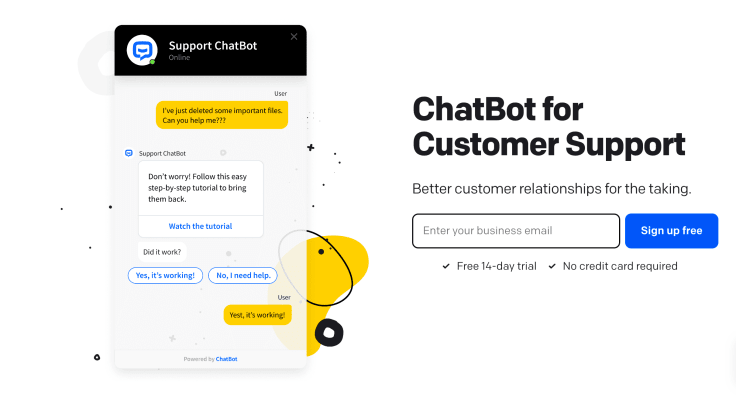
The support angle is the mirror image. Customers photograph the damaged box, the wrong color, the part that will not fit. Support that accepts images resolves those cases faster than support that asks people to describe a defect in words.
For support teams: check that attachments survive your handoffs. A photo sent in chat that vanishes when the conversation becomes a ticket is common and quietly expensive.
4. Social commerce
Social commerce crossed a threshold this year. eMarketer forecasts US social commerce sales of roughly $101 billion in 2026, up about 18% year over year and around 7.2% of total US ecommerce. TikTok Shop is the clearest single number in the category, projected at $23.41 billion in US sales, a 48% increase.
Treat platform-level GMV estimates with caution. Third-party models for the same Instagram metric range from $8.7 billion to $37.7 billion depending on who built them, so quote the source rather than the figure.
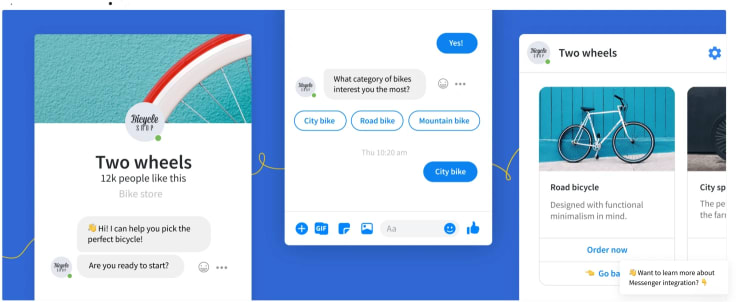
What matters operationally is that DMs on Instagram, Messenger, and TikTok are now support queues. Orders placed in-app still generate WISMO questions, return requests, and complaints, and they arrive in a different inbox from your website chat.
For support teams: if social is a real sales channel for you, it needs the same response-time target and the same escalation path as your website. ChatBot.com's Messenger integration brings those conversations into the same workspace as everything else.
5. Omnichannel
Omnichannel used to mean being present on every channel. In 2026 it means the conversation survives the move between them, and it now includes formats as well as channels. Zendesk names multimodal support across text, voice, video, and images in a single flow as a core capability of the current model.
A new wrinkle: customers increasingly arrive from AI assistants rather than search. Adobe Analytics, tracking more than a trillion visits to US retail sites, found AI-referred traffic to retail grew 138% year over year in May 2026, and 1,324% since Adobe began tracking the category in October 2024. Retail led all industries in Q1 2026 at 393% year-over-year growth in AI visit share.
Those shoppers arrive already briefed, sometimes accurately and sometimes not.
For support teams: your product data has become a support asset. When shipping terms, return windows, and stock status are accurate and machine-readable, assistants describe you correctly and fewer people reach your widget confused about what they just bought.
Worth knowing: the checkout side of this went differently than predicted. OpenAI launched Instant Checkout inside ChatGPT in September 2025, then pivoted away from in-chat purchasing and rolled out a revamped shopping experience in March 2026 that routes shoppers to merchant sites. The durable pattern is discovery in AI, purchase on your own storefront.
6. Go green or go home
Sustainability moved from consumer sentiment to enforceable law this year, and the deadline is close.
The EU's Empowering Consumers for the Green Transition Directive (EU 2024/825) applies from 27 September 2026. Member states had to transpose it by 27 March 2026. It bans generic environmental claims such as "eco-friendly" and "environmentally friendly" without substantiation, prohibits carbon-neutral claims based on offsetting, and restricts sustainability labels to those verified by an independent third party. It also requires a harmonized notice about legal guarantee rights at the point of sale. The Commission published updated guidance on 18 May 2026, clarifying that the rules extend to claims implied by brand and product names.
Penalties under EU consumer enforcement rules can reach 4% of annual turnover in the relevant member states.
For support teams: your agents answer questions about these claims, and canned responses repeating an unsubstantiated "eco-friendly" line carry the same exposure as the product page. Audit macros and knowledge base articles alongside marketing copy, not after it.
Note that this is separate from the proposed Green Claims Directive, whose negotiations are on hold. The September deadline comes from EU 2024/825.
7. Subscription-based models
Subscriptions still offer predictable revenue and convenience. What changed is the regulatory pressure on how customers leave.
The FTC's "click-to-cancel" rule was vacated by the Eighth Circuit in July 2025 on procedural grounds. It has not simply gone away. The FTC submitted an Advance Notice of Proposed Rulemaking on 30 January 2026 to revive it, and continues to bring enforcement actions under ROSCA and Section 5 in the meantime. Roughly 30 states have their own automatic-renewal laws, several stricter than the vacated federal rule.
For support teams: cancellation flows sit with support, not legal, and retention scripts that add friction are the exact practice under scrutiny. The practical read is that making it easy to leave tends to beat making it hard, both for compliance exposure and for chargeback volume.
If your AI handles cancellation requests, check what it is instructed to do before it offers a retention discount.
Grow your ecommerce business with ChatBot.com
Every trend on this list depends on one unglamorous thing: the accuracy of the product and policy content your customers and your AI both read.
ChatBot.com trains AI Agent on your own content, connects to your Shopify catalog for live product and order data, and attributes the sales it closes back to the conversation that produced them. Support, live chat, and ticketing run in one workspace, with no coding required.
Start your free 14-day trial and see what happens when your service starts selling.


